ADHD

Our ADHD assessments aim to provide a clear understanding of attention, impulsivity, and executive functioning, while carefully considering overlapping factors like anxiety, mood, and stress. Oftentimes, our approach includes:
- Clinical and structured interviews
- ADHD-specific screening measures
- Cognitive and attention testing (as needed)
- Collateral input (when helpful)
- Behavioural observations and pattern analysis
You’ll receive a clear, evidence-based report outlining:
- Whether ADHD is present
- How your brain processes attention and information
- Practical recommendations for school, work, or daily life
If you’re unsure whether ADHD is relevant, a brief consult can help determine whether a full assessment is appropriate.
AUTISM SPECTRUM DISORDER (ASD)
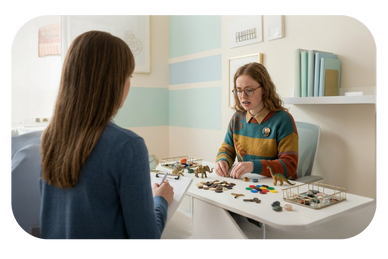
Our ASD assessments aim to provide a clear understanding of social communication, behavioural patterns, and sensory processing, while carefully considering overlapping conditions and individual differences. Oftentimes, our approach includes:
- Clinical and structured interviews
- Autism-specific screening and assessment tools
- Observational assessment (when appropriate)
- Cognitive testing (as needed)
- Collateral input (when helpful)
- Behavioural observations and developmental history
You’ll receive a clear, evidence-based report outlining:
- Whether ASD is present
- Your or your child’s pattern of strengths and differences
- Practical recommendations for school, work, and daily life
GIFTEDNESS
PSYCHOEDUCATIONAL

Our giftedness assessments aim to provide a clear understanding of cognitive strengths, learning style, and areas of intensity or uneven development, helping guide appropriate supports and next steps. Oftentimes, our approach includes:
- Clinical and developmental interviews
- Standardized cognitive (IQ) testing
- Assessment of cognitive strengths and processing style
- Consideration of attention, learning, and emotional factors
- Collateral input (when helpful)
- Behavioural observations and pattern analysis
Outcome:
You’ll receive a clear, evidence-based report outlining:
- Whether giftedness is present
- A detailed cognitive profile (strengths and relative weaknesses)
- Practical recommendations for school, work, and daily functioning
PSYCHOEDUCATIONAL
PSYCHOEDUCATIONAL

Our psychoeducational assessments aim to provide a clear understanding of how you or your child learns, processes information, and performs across cognitive and academic areas, helping identify learning differences and guide effective supports. Our approach often includes:
- Clinical and developmental interviews
- Standardized cognitive (IQ) testing
- Academic achievement testing (reading, writing, math)
- Assessment of attention, memory, and processing
- Collateral input (e.g., school or teacher information, when helpful)
- Behavioural observations and pattern analysis
You’ll receive a clear, evidence-based report outlining:
- Cognitive and academic strengths and weaknesses
- Whether a learning disorder or related difficulty is present
- Practical recommendations for school, work, and daily functioning
PSYCHODIAGNOSTIC

Our psychodiagnostic assessments aim provide a clear understanding of mood, anxiety, trauma-related, and personality patterns, helping clarify what’s going on and what support will be most effective. Our approach often includes:
- Clinical and structured diagnostic interviews
- Standardized mental health measures (e.g., mood, anxiety, trauma, personality)
- Symptom and pattern analysis across contexts
- Consideration of developmental, medical, and psychosocial factors
- Behavioural observations and clinical integration
You’ll receive a clear, evidence-based report outlining:
- Diagnostic clarification (when appropriate)
- A comprehensive understanding of symptom patterns
- Practical recommendations for treatment and next steps
TWICE EXCEPTIONAL (2E)
Twice-exceptional (2e) assessments are designed for individuals who may be both gifted and experiencing learning, attention, or other neurodevelopmental differences. This assessment helps clarify complex, uneven profiles and guide appropriate supports. Our approach often includes:
- Clinical and developmental interviews
- Standardized cognitive (IQ) testing
- Academic achievement testing (as needed)
- Assessment of attention, executive functioning, and learning processes
- Consideration of emotional and behavioural factors
- Collateral input (when helpful)
- Behavioural observations and integrative pattern analysis
You’ll receive a clear, evidence-based report outlining:
- Whether a twice-exceptional profile is present
- A detailed understanding of strengths and areas of difficulty
- Practical recommendations for school, work, and daily functioning